
Food Equity in Focus: A Radical Look At The Social Determinants Of Health
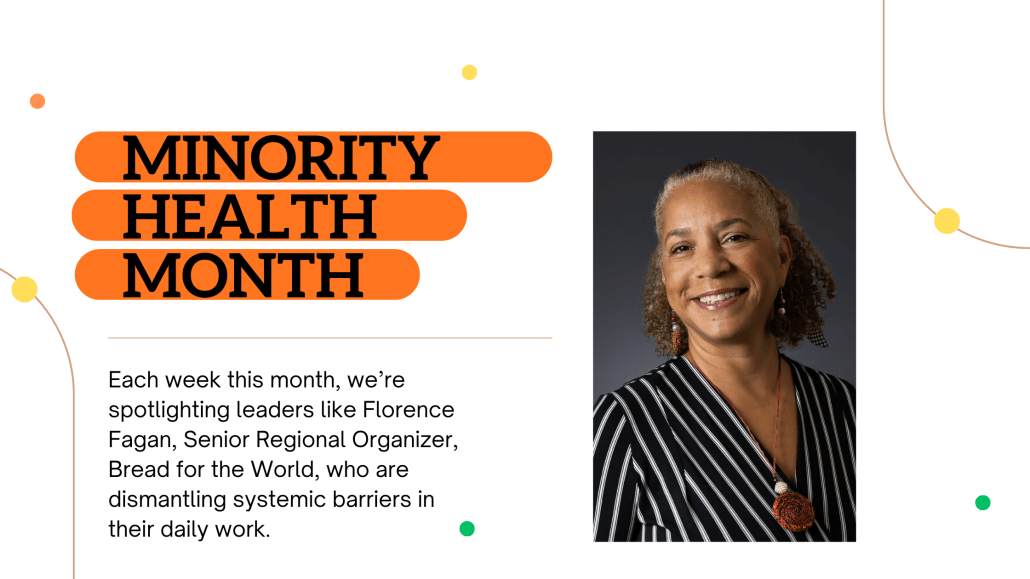
Is hunger a personal failure or a policy failure? Sitting between the crux of access and livability, the answer is strikingly clear: it’s a challenge; however, it’s a challenge that many faith-based organizations and non-profits are addressing in their pivotal work. Minority Health Month is allotted for taking a radical look at the social determinants of health that drive food insecurity in America. Today, we’re centering a leadership perspective from Bread for the World, a non-partisan organization at the forefront of the fight against hunger. During our conversation, we discussed why it’s necessary to dismantle the “stigma barrier,” the essential infrastructure of SNAP and WIC, and why the nation’s health leaders must advocate for living wages and affordable housing.
Below, take a look at our conversation, which spans how community-led advocacy is integral to our more equitable and sustainable food system and more.
At Bread for the World, you’re looking at the intersection of access and livability. In your experience, what do you feel directly impacts a person’s ability to secure nutritious food for their family in the U.S. right now?
Right now, a person’s ability to secure nutritious food for their family is directly shaped by wage, housing costs, limited access to healthcare and education, and geography [in addition to] transportation.
In Florida, for example, you need to make around $32 an hour to afford a modest two‑bedroom apartment, but the minimum wage is roughly $15 an hour. That means even with two full‑time jobs, families are barely keeping their heads above water.
Housing costs [also] crowd the food budget. Rent and utilities have climbed so high that many families are choosing between paying for housing and buying groceries. When housing eats up most of the paycheck, food — especially nutritious food like fruits and vegetables — becomes the first thing to be downgraded.
Without healthcare, chronic conditions go unmanaged, and people often rely on cheaper, less nutritious options just to get by. On top of that, limited access to education and literacy, including adult education and GED programs, directly constrains earning potential and long‑term food security.
[Regarding geography and transportation] whether someone lives in a rural community without reliable transportation, or in a neighborhood where the nearest full‑service grocery store is far away, their address can determine whether they have realistic access to healthy options at all.
This feature highlights individuals leading the charge in food equity. As a leader in this space, what is one systemic barrier to food access that you feel is finally being dismantled, and what role does community-led advocacy play in that shift?
One systemic barrier that’s finally beginning to crack is the assumption that hunger is an individual failure instead of a policy failure.
For a long time, programs like WIC, SNAP, and the Child Tax Credit were framed narrowly, and the people using them were often stigmatized. What we’re seeing now—especially since the pandemic — is a growing recognition that:
- These programs are essential infrastructure, not charity.
- Policy design (who qualifies, how easy it is to apply, whether services can be accessed remotely) can either support or block families from meeting basic needs.
As more communities organize, tell their stories, and hold elected officials accountable, we’re seeing a slow but real move away from shame‑based narratives toward policy‑based solutions. That is the barrier being dismantled: the belief that hunger is inevitable and purely personal, rather than solvable through just and evidence‑based policy.
In honor of Minority Health Month, what do you believe is the most critical step the nation’s health leaders can take right now to ensure that food security is treated as a fundamental human right?
I believe the most critical step the nation’s health leaders can take is to treat food security as a core health issue, not an optional add‑on—and to enshrine it as a basic right tied to human dignity.
From a faith and moral perspective, every person has a right to flourish. That includes the right to food, the right to clean water, [and] the right to safe, stable housing. All three are under pressure in the United States right now—not in a distant country, but here at home.
For health leaders, that means embedding food security in health and practice, championing policies that address root causes, backing bipartisan, evidence-based legislation, and centering dignity, not stigma.
Food access should be integrated into how we design healthcare systems, Medicaid and Medicare policies, maternal and child health programs, and community health initiatives—particularly in communities of color that face overlapping burdens of racism, economic inequality, and environmental risk.
[Notably], health leaders need to openly support living wages, affordable housing, and accessible healthcare as health interventions. Hunger is deeply connected to these structural realities.
Supporting measures that strengthen WIC, SNAP, the Child Tax Credit, and student food security protections is not partisan — it is a recognition that these programs demonstrably reduce hunger and improve health outcomes, especially for children and marginalized communities.
The language we use matters. Framing food programs as a rightful support for human flourishing—rather than a last resort for the “deserving poor”—helps remove shame and encourages people to seek the help they qualify for.
Stay tuned for more features on the leaders driving food equity in Florida. Sign up for our newsletter to get the next interview delivered straight to your inbox.


Leave a Reply
Want to join the discussion?Feel free to contribute!