Why National Health Leaders Must Finally Treat Nutritious Food Access As A Human Right

Food equity is a hot-button topic this year. What has changed? The SNAP updates span eligibility requirements, work mandates, benefit amounts, and even the specific inventory grocery stores must stock to accept SNAP, as reported by The New York Times. Arely B. Lozano Cantú, Director of Health Access and Livability, Urban Health Partnerships, is regularly working to showcase that food access is a human right in her daily work. 

Cantú sits in a unique position. In a conversation, she delves into what realistic and consistent perspectives we must pay attention to regarding food accessibility. Higher prices mean trade-offs between “food, housing, and other essentials,” explains Arely. 

Below, take a look at our conversation, which spans why food equity must be seen as a human right, what barriers are standing in the way of equitable options for marginalized populations, and more. 

At Urban Health Partnerships, you’re looking at the intersection of access and livability. In your experience, what do you feel directly impacts a person’s ability to secure nutritious food for their family in the U.S. right now?

At the most immediate level, it’s not just whether food exists: it’s whether people can realistically and consistently access quality, nutritious food within their daily lives and spaces. From what we see on the ground, there are multiple layers shaping that reality.

First is quality and affordability. While we produce a significant amount of food in places like Florida, and especially in South Florida, much of it leaves the region, and communities are left with higher prices and limited access to fresh, culturally relevant foods. At the same time, rising costs of living and economic instability mean families are constantly making trade-offs between food, housing, and other essentials.

Then there are infrastructure and access barriers: transportation, walkability, time, and the ability to navigate fragmented systems. Even when food resources exist, people often don’t know where to go, when, or what’s available.

Finally, there are cultural, policy, and social factors, including access to culturally familiar foods, shifting policies like SNAP [food benefits], and the stigma associated with seeking support. So the issue isn’t just food availability: it’s whether systems are connected, affordable, and designed around how people actually live.
As a leader in this space, what is one systemic barrier to food access that you feel is finally being dismantled, and what role does community-led advocacy play in that shift?

One of the most important barriers being dismantled right now is the long-standing separation between food systems and healthcare systems. For decades, food access was treated as a social issue, while healthcare focused on treatment, thus missing the fact that nutrition is integral to health.

We’re now seeing a shift toward recognizing food as a core component of care through “Food as Medicine” approaches and stronger cross-sector coordination. That shift didn’t happen on its own, though; it is the result of community-led advocacy.

Impacted folks have consistently elevated the reality that food insecurity is about more than hunger: it is about access, dignity, community, chronic disease prevention, and long-term health. Grassroots organizations, community leaders, and individuals with lived experience have been pushing institutions to rethink how systems are designed and to update the action around this issue.

At the same time, local advocacy—whether it’s changes in land use, community access to public spaces, or state and federal nutrition policies—has helped create openings for more equitable food systems. That combination of lived experience, community-driven local and systemic mobilization, [in addition to] advocacy is what’s driving real change.

In honor of Minority Health Month, what is the most critical step the nation’s health leaders can take right now to ensure that food security is treated as a fundamental human right?

The most critical step is for national leaders to fundamentally shift how we view food: from a commodity to a necessity and a right.

Our bodies depend on nutrition to function, grow, and thrive. Yet our systems often treat food as optional, influenced by politics, policy, and economics rather than human need. As a result, we see both food insecurity and food waste existing at the same time: a very clear indication that the system is misaligned.

If we truly believe food is a human right, then it must be integrated into how we design health systems, policies, and funding structures. That means ensuring that food access is embedded into healthcare, that resources are coordinated across sectors, and that policies support equitable distribution rather than fragmentation.

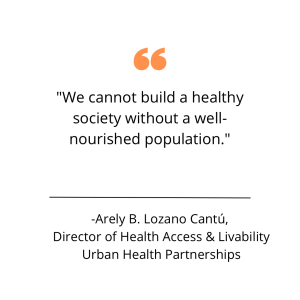
Ultimately, we cannot build a healthy society without a well-nourished population. When people are fed well, communities are stronger, systems function better, and health outcomes improve. That shift in mindset, and systems, is what’s needed now.
Food Equity in Focus: A Radical Look At The Social Determinants Of Health

Is hunger a personal failure or a policy failure? Sitting between the crux of access and livability, the answer is strikingly clear: it’s a challenge; however, it’s a challenge that many faith-based organizations and non-profits are addressing in their pivotal work. Minority Health Month is allotted for taking a radical look at the social determinants of health that drive food insecurity in America. Today, we’re centering a leadership perspective from Bread for the World, a non-partisan organization at the forefront of the fight against hunger. During our conversation, we discussed why it’s necessary to dismantle the “stigma barrier,”  the essential infrastructure of SNAP and WIC, and why the nation’s health leaders must advocate for living wages and affordable housing.

Below, take a look at our conversation, which spans how community-led advocacy is integral to our more equitable and sustainable food system and more. 

At Bread for the World, you’re looking at the intersection of access and livability. In your experience, what do you feel directly impacts a person’s ability to secure nutritious food for their family in the U.S. right now?

Right now, a person’s ability to secure nutritious food for their family is directly shaped by wage, housing costs, limited access to healthcare and education, and geography [in addition to] transportation. 

In Florida, for example, you need to make around $32 an hour to afford a modest two‑bedroom apartment, but the minimum wage is roughly $15 an hour. That means even with two full‑time jobs, families are barely keeping their heads above water.

Housing costs [also] crowd the food budget. Rent and utilities have climbed so high that many families are choosing between paying for housing and buying groceries. When housing eats up most of the paycheck, food — especially nutritious food like fruits and vegetables — becomes the first thing to be downgraded.

Without healthcare, chronic conditions go unmanaged, and people often rely on cheaper, less nutritious options just to get by. On top of that, limited access to education and literacy, including adult education and GED programs, directly constrains earning potential and long‑term food security.

[Regarding geography and transportation] whether someone lives in a rural community without reliable transportation, or in a neighborhood where the nearest full‑service grocery store is far away, their address can determine whether they have realistic access to healthy options at all.

This feature highlights individuals leading the charge in food equity. As a leader in this space, what is one systemic barrier to food access that you feel is finally being dismantled, and what role does community-led advocacy play in that shift?

One systemic barrier that’s finally beginning to crack is the assumption that hunger is an individual failure instead of a policy failure.

For a long time, programs like WIC, SNAP, and the Child Tax Credit were framed narrowly, and the people using them were often stigmatized. What we’re seeing now—especially since the pandemic — is a growing recognition that:

  • These programs are essential infrastructure, not charity.
  • Policy design (who qualifies, how easy it is to apply, whether services can be accessed remotely) can either support or block families from meeting basic needs.

As more communities organize, tell their stories, and hold elected officials accountable, we’re seeing a slow but real move away from shame‑based narratives toward policy‑based solutions. That is the barrier being dismantled: the belief that hunger is inevitable and purely personal, rather than solvable through just and evidence‑based policy.

In honor of Minority Health Month, what do you believe is the most critical step the nation’s health leaders can take right now to ensure that food security is treated as a fundamental human right?

I believe the most critical step the nation’s health leaders can take is to treat food security as a core health issue, not an optional add‑on—and to enshrine it as a basic right tied to human dignity.

From a faith and moral perspective, every person has a right to flourish. That includes the right to food, the right to clean water, [and] the right to safe, stable housing. All three are under pressure in the United States right now—not in a distant country, but here at home.

For health leaders, that means embedding food security in health and practice, championing policies that address root causes, backing bipartisan, evidence-based legislation, and centering dignity, not stigma.

Food access should be integrated into how we design healthcare systems, Medicaid and Medicare policies, maternal and child health programs, and community health initiatives—particularly in communities of color that face overlapping burdens of racism, economic inequality, and environmental risk.

[Notably], health leaders need to openly support living wages, affordable housing, and accessible healthcare as health interventions. Hunger is deeply connected to these structural realities.

Supporting measures that strengthen WIC, SNAP, the Child Tax Credit, and student food security protections is not partisan — it is a recognition that these programs demonstrably reduce hunger and improve health outcomes, especially for children and marginalized communities.

The language we use matters. Framing food programs as a rightful support for human flourishing—rather than a last resort for the “deserving poor”—helps remove shame and encourages people to seek the help they qualify for.

Stay tuned for more features on the leaders driving food equity in Florida. Sign up for our newsletter to get the next interview delivered straight to your inbox.

Healthy SNAP in Florida

As Florida prepares to implement changes to the Supplemental Nutrition Assistance Program (SNAP) through a federal demonstration project, communities across the state are beginning to ask important questions—not just about what is changing, but what those changes will mean in practice.

At Florida Impact, our work is rooted in listening to communities, lifting up lived experiences, and ensuring that families have access to the resources they need to thrive. As this new phase of SNAP unfolds, we are paying close attention to both the policy and the realities on the ground.

What Is Changing Under Healthy SNAP?

Beginning in 2026 through the end of 2027, Florida will participate in a USDA-approved demonstration project that places restrictions on certain SNAP purchases. During this period, SNAP benefits cannot be used to buy:

  • Soda and energy drinks (including regular, diet, and zero-sugar varieties)

  • Candy

  • Prepared desserts (ultra-processed, shelf-stable items like packaged snack cakes)

According to the U.S. Department of Agriculture (USDA), the purpose of this demonstration is to better understand whether these changes lead to improvements in diet-related health outcomes, shifts in purchasing behavior, and increased nutrition knowledge among SNAP participants.

This marks a notable shift for a program that has historically prioritized flexibility for families making food choices.

What We’re Hearing from Communities

Across Florida, especially in areas with limited access to grocery stores, these changes are raising practical concerns.

In Tampa’s University Area—often described as a food desert—residents frequently rely on nearby dollar stores or small retailers. These stores are often the closest and most accessible option, even if they do not carry a wide range of fresh or healthy foods.

As Letitia Haley Brown (University Area CDC Chief Operating Officer) shared in a recent news report, many families shop based on what is available nearby, not necessarily what they would prefer if given more options. This highlights an important reality: access shapes choice.

Community Leadership in Action

Organizations are already working hard to meet the moment and increase access to healthy food. Beyond starting community gardens, local efforts include:

  • Nutrition education classes

  • Food drives and distributions

  • Partnerships with nearby stores to increase healthy inventory

Community leaders are also exploring ways to introduce SNAP participants to alternative foods that remain eligible, helping bridge the gap between policy changes and everyday decision-making.

The Broader Policy Context

These changes are being implemented at a time when Florida is already navigating significant shifts within SNAP. The state is currently working to manage funding changes associated with HR 1 cuts and urgent efforts to reduce error rates to meet federal USDA requirements.

Together, these factors add new layers of responsibility for the Florida Department of Children and Families (DCF), a system that has already faced capacity challenges. Retailers are also part of this equation. Industry groups have raised concerns that new restrictions may create additional compliance requirements, particularly for smaller stores that serve as primary food sources in many communities.

What This Means Moving Forward

At Florida Impact, we recognize that policies do not operate in isolation. As Healthy SNAP moves forward, we will be watching several critical factors:

  • Access: Are healthier food options available and affordable in all communities?

  • Education: Do families have the information and support needed to navigate changes?

  • Implementation: How are agencies and retailers adapting to new requirements?

  • Community Voice: Are the experiences of SNAP participants being heard and considered?

Access, dignity, and equity should remain at the center of every conversation about food and health.

Advocating for Florida’s Children During Children’s Week

Florida Children’s Week brings together advocates, families, and community leaders from across the state to focus on the well-being of Florida’s children. Each year during the legislative session in Tallahassee, organizations gather to speak with lawmakers and highlight the policies that affect children and families. Florida Impact was proud to participate in this year’s Children’s Week events, joining partners and advocates to help ensure that the voices of Florida’s children remain at the center of important policy conversations.

Our week began with Florida Advocacy Days, a training designed to equip faith leaders and community partners with the tools they need to advocate effectively. Participants learned how to follow legislation, communicate with policymakers, and share stories from their communities that illustrate the real impact of public policy. Nearly 80 participants joined the training both in person and online. We were grateful for the insights shared by statewide partners including the Florida Policy Institute, Poverty Solutions Group, and the Florida Health Justice Project.

Throughout Children’s Week, advocates also met with lawmakers at the Florida Capitol to discuss key issues affecting families across the state. Conversations focused on topics such as food access, healthcare, and the importance of investing in public education. These meetings are an important part of the advocacy process because they give community members the opportunity to speak directly with decision-makers about the challenges families face and the solutions that can make a difference.

Florida Impact also participated in Storybook Village, a popular Children’s Week tradition where organizations connect with children and families through fun activities and educational experiences. At our table, children enjoyed jump rope games, chess, and small giveaways while learning about the importance of healthy communities. One especially meaningful part of the event was the Hanging of the Hands display. Students from the Eccleston Elementary School Nutrition Club contributed handprints and messages about their families and schools. Their words were a powerful reminder of why protecting the well-being of children must remain a priority.

The week concluded with Teen Day at the Capitol, where students from Florida Impact’s GEMS program experienced civic engagement firsthand. Students had the opportunity to meet with lawmakers, observe legislative proceedings from the House Gallery, and participate in workshops led by legislative staff. These sessions helped students better understand how government works and how young people can play a role in shaping their communities. The visit concluded with a tour of Florida A&M University, giving students an inspiring look at future opportunities in higher education and leadership.

Although Children’s Week has come to an end, the work of supporting children and families continues throughout the year. Florida Impact remains committed to strengthening communities, advancing policies that reduce hunger, and advocating for programs that support the health and well-being of Florida’s children. We are grateful to every partner, advocate, and student who helped make this year’s Children’s Week a meaningful and impactful experience.

Keep Kids Fed and Thriving This Summer with Summer BreakSpot

When school lets out, many Florida children lose access to the healthy meals they rely on during the school year. Summer BreakSpot is here to ensure no child goes hungry. This statewide program provides free, nutritious meals to children and teens under 18 all summer long — no application, no ID, and no registration required. Meals are available at convenient locations like schools, parks, libraries, and community centers.

Summer BreakSpot does more than just fill empty stomachs. It helps kids stay active, healthy, and ready to learn when school starts again. For parents and caregivers, it’s a critical support during the summer months when household food budgets are often stretched thin. Access to free meals means families don’t have to choose between paying bills and putting food on the table.

Finding a Summer BreakSpot is easy — just visit Summer BreakSpot Food Service Program – Florida kids count on Summer BreakSpot for meals when school is out. to locate a site near you. The website is mobile-friendly and allows you to search by zip code to find nearby meal locations and schedules.

If you’re an organization hosting a summer program for youth and need help providing meals, we can assist you. Our team can help connect you with a local Summer BreakSpot sponsor so your program participants can receive free meals throughout the summer. Nutritious food supports better participation, learning, and engagement — and we’re here to make it easy for your program to be part of this important effort.

Together, we can make sure every child in Florida has the food they need to grow, learn, and enjoy their summer. Spread the word and reach out to us if you’d like support becoming a meal site.

Protect Florida Families from Harmful Federal Cuts

Congress is considering the most drastic cuts to Medicaid and SNAP in our nation’s history — and Florida stands to lose the most. The proposed House reconciliation bill includes $723 billion in Medicaid cuts over the next decade, stripping $16 billion from Florida alone. SNAP changes could force 423,000 Floridians off food assistance and shift $1.6 billion in costs to the state starting in 2028. For the first time ever, Florida would be required to pay up to 25% of SNAP benefits — a sharp increase from the current 0%. These cuts would devastate working families, destabilize our economy, and force Florida to make impossible budget choices.

The stakes are enormous. Over 4 million Floridians rely on Medicaid, including children, seniors, and people with disabilities. Nearly 3 million depend on SNAP to put food on the table — 41% of whom are children and 25% seniors. Low-wage workers, rural communities, and 120,000 low-income seniors (the highest number in any state) would lose vital coverage and support. Florida is already facing a $2.8 billion deficit in FY 2026–27 — ballooning to $6.9 billion the following year. These federal cuts would only deepen the crisis, forcing the state to raise billions in new revenue or slash essential programs like Medicaid and SNAP.

This isn’t just a policy issue — it’s a human one. Without SNAP, families go hungry, and the burden falls on already overstretched food banks. Right now, SNAP provides nine meals for every one meal offered by a food bank. We simply cannot fill the gap. Florida could lose nearly 45,000 jobs and more than $4.5 billion in GDP. These cuts would mean less care, less food, and more hardship for those who can least afford it.

Take Action Today:
We must raise our voices now. Call your members of Congress and tell them Florida cannot absorb these devastating cuts. Share this alert with your networks and help us protect critical lifelines for millions. Together, we can stand up for Florida families and defend the services that keep our communities healthy, fed, and strong. If you need support in advocating for this cause please contact us  here at Florida Impact.

  • Click here for a link to the recording on YouTube
  • Click here to access the letter signed by 77 organizations urging Florida’s U.S. Senate delegation to reject cuts to health care and food assistance

Urge Your Senators to Support School Meals

Earlier this month, FRAC’s Interim President Crystal FitzSimons testified at a hearing held by the Senate Agriculture Subcommittee on Food and Nutrition. The hearing was entitled, “Keeping Kids Learning in the National School Lunch Program and School Breakfast Program”.

FRAC’s testimony focused on the critical role the school nutrition programs play in supporting student nutrition, health, and learning, as well as the following legislation Senators can co-sponsor to strengthen and expand the programs.

The Universal School Meals Programs Act (S.1568) would make Healthy School Meals for All nationwide.
The School Hunger Elimination Act (S.4525) would increase federal funding for community eligibility schools, create a statewide community eligibility option, improve direct certification, and provide retroactive reimbursement for meals served to children who are certified for free or reduced price meals later in the school year.

The Nutrition Red Tape Reduction Act (S.4523) would put into statute the 25 percent Identified Student Percentage threshold for schools to participate in the Community Eligibility Provision.

Please take a moment to email your Senators and urge them to follow up on the hearing by adding their names to important child nutrition bills that will ensure students are hunger-free. You can use the FRAC Action Network to easily send a pre-populated email, or craft your own, and directly reach your Senators.

Hunger Action Month

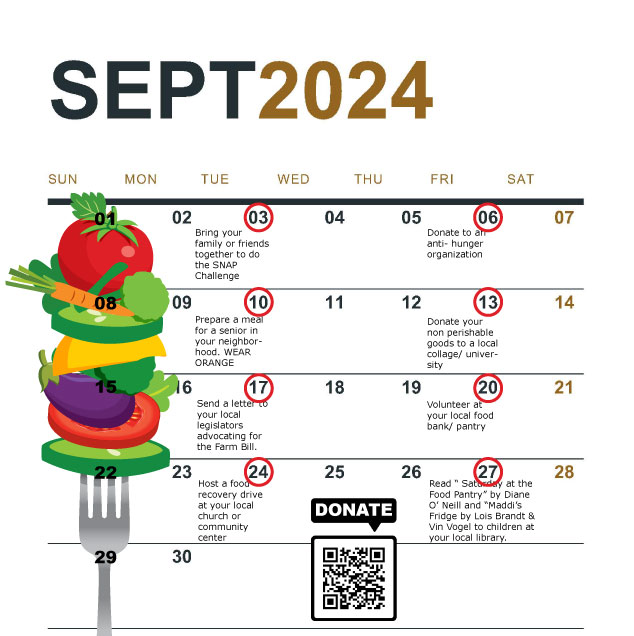
September is Hunger Action Month a time when organizations and dedicated individuals across the country emphasize the importance of ending hunger by taking action. The calendar below has different things that you can do to help raise awareness about food insecurity. To help support our anti- hunger efforts you can donate at www.floridaimpact.org.

Check out our calendar to participate in these activities.

  • Bring your family or friends together to do the SNAP Challenge
  • Donate to an anti- hunger organization
  • Prepare a meal for a senior in your neighborhood
  • Donate your non perishable goods to a local collage/ university
  • Send a letter to your local legislators advocating for the Farm Bill. Letter to Congressional Leaders in Support of a Resilient, Equitable, and Sustainable 2024 Farm Bill (google.com)
  • Volunteer at your local food bank/ pantry
  • Host a food recovery drive at your local church or community center
  • Read “ Saturday at the Food Pantry” by Diane O’ Neill and “Maddi’s Fridge by Lois Brandt & Vin Vogel to children at your local library.

Urge Your Senators to Pass Improvements to the Child Tax Credit

The Tax Relief for American Families and Workers Act (H.R. 7024) is scheduled to be voted on by the Senate this Thursday afternoon. This legislation includes important Child Tax Credit (CTC) improvements that would improve food security and lift families with children out of poverty. The House overwhelmingly passed the bill (357–70) back in January.

It is essential that the Senate seize this opportunity to pass legislation that would support children in families struggling to put food on the table. The bill includes improvements to the CTC that would benefit nearly 16 million out of the 19 million children currently left out of the full or any CTC and lift 400,000 children out of poverty within the first year alone.

Now that this overwhelmingly popular, bipartisan bill is scheduled for a vote in the Senate: Senators must vote “yea” on both the procedural vote (“cloture”) and final passage. Hungry children cannot wait.

Take Action Now

  • Use the FRAC Action Networkto immediately send an email to your Senators urging them to vote “yea” on the Tax Relief for American Families and Workers Act (H.R. 7024).
  • Share this FRAC leave-behind with your Senators and others on why the CTC must be expanded to address poverty and hunger.

Make Sure No Child Goes Hungry NEXT Summer.

Did you know that over 2 million children in Florida could benefit from the Summer Electronic Benefits Transfer (Summer EBT) program? This federal initiative ensures that children who rely on school lunches continue to receive nutritious meals throughout the summer.

During the recent legislative session, Florida Impact and dedicated advocates like you urged lawmakers to authorize and fund the Florida Department of Children and Families (DCF) to apply for the 2025 Summer EBT. The clock is ticking, and Florida has until August 15, 2024, to submit its intent to administer this vital program.

We need your help to ensure that the Florida DCF seizes this crucial opportunity. Please take a moment to send an email to DCF Secretary Shevaun Harris, urging her to take the necessary steps to provide meals for hungry Florida children next summer. To support us in our efforts, follow this link to send your letter to the DCF: https://action.splcenter.org/a/feed-fl.
Together, we can make a difference. Thank you for your support.